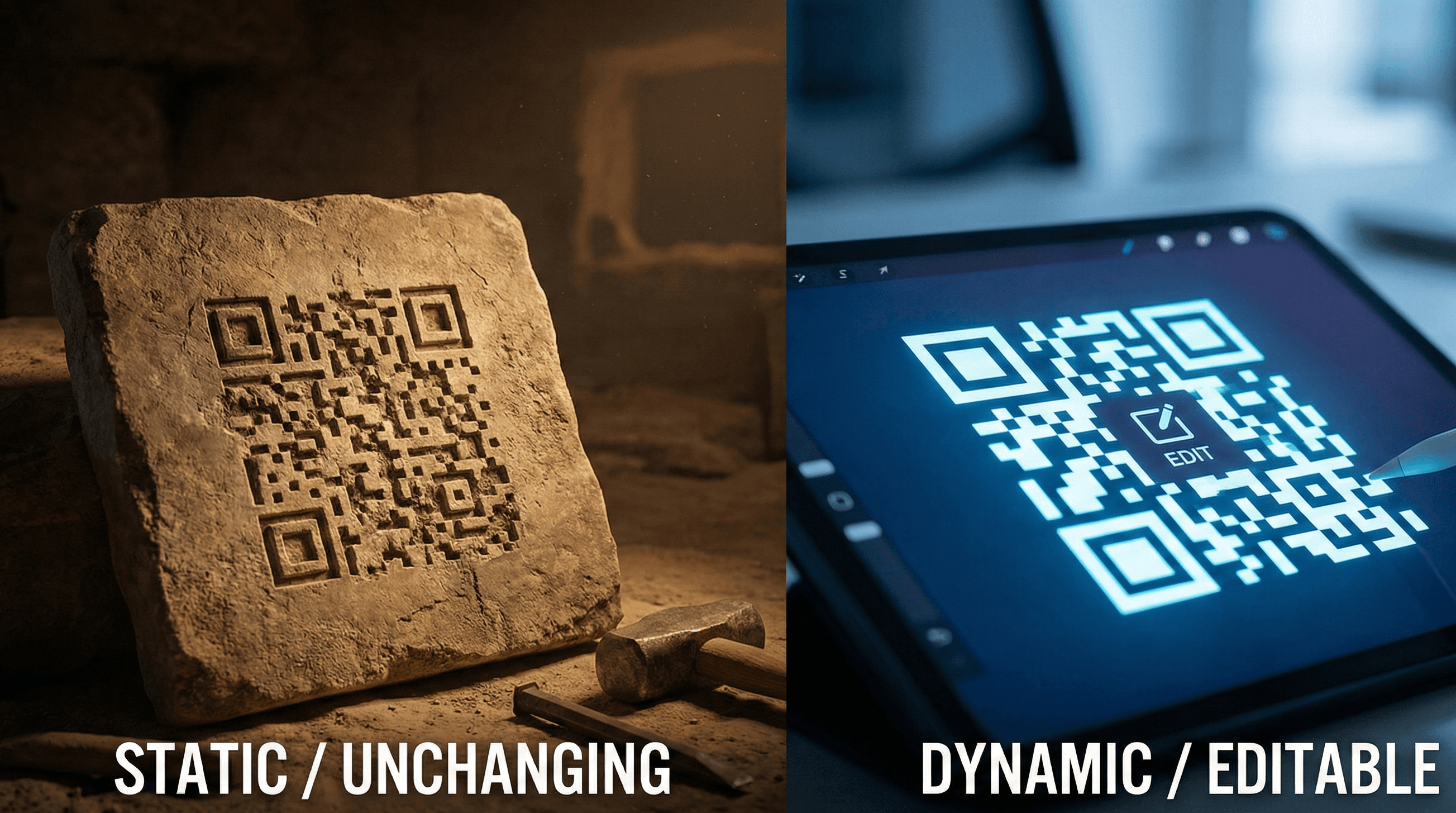
The Fundamental Difference
Static QR Code: The destination is encoded directly in the pattern. It can never be changed.
Dynamic QR Code: The code points to a redirect URL. The final destination can be changed anytime.
Think of it like addresses:
- Static = Your data carved in stone
- Dynamic = A forwarding address that you control
Static QR Codes Explained
How They Work
The actual data (URL, WiFi password, contact info) is encoded directly into the QR pattern. When scanned, phones read this data directly—no internet connection or third-party service needed.
Advantages of Static QR Codes
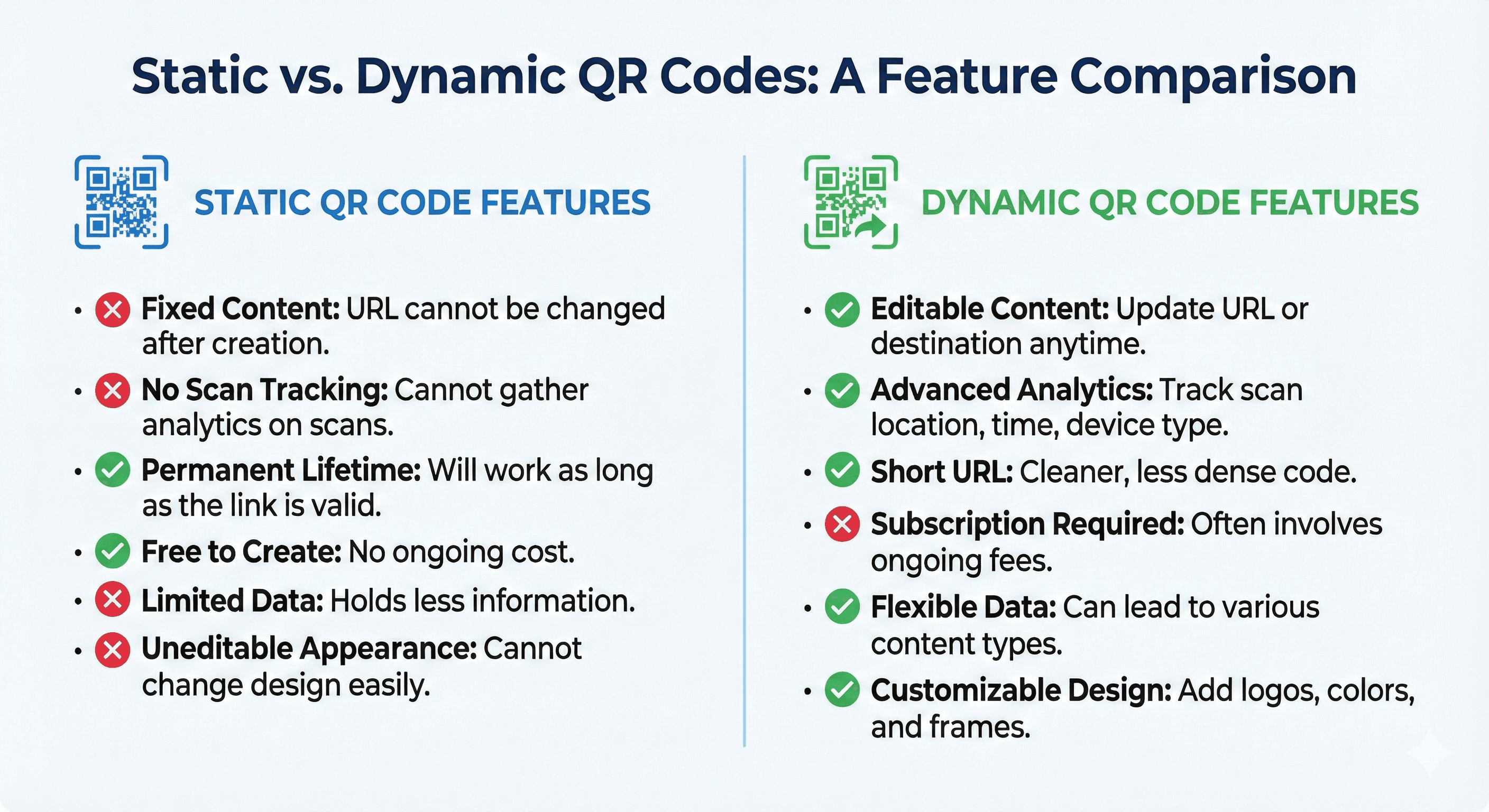
✅ No ongoing costs Create once, use forever. No subscriptions, no renewals.
✅ Works offline WiFi codes, vCards, and text work without internet. Perfect for:
- Guest WiFi passwords
- Contact information
- Event details
- Plain text messages
✅ No third-party dependency Your code works even if our service disappears. It's truly yours.
✅ Faster scanning No redirect hop means instant access to content.
✅ Maximum privacy No tracking, no data collection, no logs.
✅ Unlimited scans No caps, no throttling, no surprises.
Disadvantages of Static QR Codes
❌ Cannot be edited Changed your URL? You need new QR codes and new prints.
❌ No analytics You won't know how many people scanned or when.
❌ Longer URLs = bigger codes A 100-character URL creates a denser, harder-to-scan code.
❌ Typos are permanent One mistake means reprinting everything.
Best Use Cases for Static QR Codes
| Use Case | Why Static Works |
|---|---|
| WiFi passwords | Works offline, no tracking needed |
| vCard contacts | Direct to phone contacts, offline |
| Permanent URLs | Links that won't change (homepage) |
| Product manuals | Stable documentation links |
| Personal business cards | Simple, no subscription |
| One-time events | No need to update after |
Dynamic QR Codes Explained
How They Work
The QR code contains a short redirect URL (e.g., qr.example.com/abc123). When scanned, this URL redirects to your actual destination. You can change the destination anytime through a dashboard.
The flow:
- User scans QR code
- Phone opens short URL
- Server redirects to your destination
- User lands on final page
Advantages of Dynamic QR Codes
✅ Edit destination anytime Changed URLs, fixed typos, updated campaigns—no reprinting needed.
✅ Full analytics Track scans, locations, devices, times, and more.
✅ Smaller QR codes Short redirect URLs create simpler, easier-to-scan codes.
✅ A/B testing Send different users to different pages to test performance.
✅ Retargeting potential Build audiences based on who scanned.
✅ Expiration controls Set codes to expire after a date or scan count.
Disadvantages of Dynamic QR Codes
❌ Ongoing subscription costs Typically $5-50/month depending on features and volume.
❌ Dependency on service provider If the redirect service goes down, your codes stop working.
❌ Requires internet Scanners need connectivity (not for WiFi/vCard use anyway).
❌ Slight delay The redirect adds ~100-500ms to load time.
❌ Privacy considerations Scans are logged and tracked.
Best Use Cases for Dynamic QR Codes
| Use Case | Why Dynamic Works |
|---|---|
| Marketing campaigns | Track performance, update offers |
| Seasonal menus | Change without reprinting |
| Product packaging | Update manuals, recalls |
| Real estate signs | Reassign to new listings |
| Event materials | Update schedules, venues |
| A/B testing | Test different landing pages |

Decision Framework
Ask yourself these questions:
Question 1: Will the destination ever change?
- No → Static (unless you need analytics)
- Yes → Dynamic
- Maybe → Dynamic (safer choice)
Question 2: Do you need scan analytics?
- No → Static is fine
- Yes → Dynamic required
- Nice to have → Consider your budget
Question 3: Is this for offline use?
- WiFi, vCard, text → Static (works offline)
- URL that needs tracking → Dynamic
Question 4: What's your budget?
- Zero ongoing cost → Static
- Can afford $10-30/month → Dynamic for important campaigns
- Enterprise budget → Dynamic with premium analytics
Question 5: How many will you print?
- < 100 units → Static (easy to reprint)
- 100-1000 units → Consider dynamic
- > 1000 units → Dynamic strongly recommended
Hybrid Approach: Best of Both
You don't have to choose one type for everything. Smart businesses use both:
Static QR Codes For:
- WiFi access (create once, forget)
- Personal business cards
- Contact information
- Evergreen content links
- Simple one-page info
Dynamic QR Codes For:
- Marketing campaigns
- Seasonal promotions
- Product packaging (high volume)
- Real estate (reassignable)
- Anything you need to track or might update
Cost Comparison
Static QR Code Costs
- Preview: Free using our generator.
- Download: One $4.97 payment for one static QR code in 4096px PNG, SVG, and real PDF.
- Ongoing QR fees: No subscription or per-scan charge from GenerateQR.
- Destination costs: A linked website or file still needs to remain available; its hosting costs are separate.
Preview your static QR code before purchasing the professional files. GenerateQR does not offer dynamic codes, hosted redirects, or scan tracking.
Dynamic QR Code Costs
Dynamic QR providers set their own prices, scan limits, and renewal terms. Check the current plan and what happens to printed codes if you cancel before committing.
Compare the provider's total cost over your intended use period with actual reprint quotes and the value of destination editing or analytics to your project. Neither savings nor a fixed five-year cost can be assumed.
Our Recommendation
Default to static for:
- Personal use
- Small businesses on a budget
- Offline applications
- Stable, unchanging links
Upgrade to dynamic when:
- Running marketing campaigns
- Printing high volumes (>500 units)
- Analytics are important
- URLs might change
- A/B testing is planned
Making Static Codes More Flexible
If you want static codes with some flexibility, try this approach:
- Create a dedicated landing page on YOUR domain (e.g., yoursite.com/qr)
- Generate a static QR code pointing to this page
- Update the page content whenever needed
Benefits:
- You control the destination
- No third-party dependency
- Free analytics via Google Analytics
- Can redirect if needed (via your server)
Limitations:
- Requires web hosting
- Basic analytics only
- Redirect requires technical setup